Sunday, July 3, 2011

A Visit to Tiny Telephone

Tiff and I were fortunate enough to attend John Vanderslice's special performance with the Magik*Magik Orchestra at the Herbst Theatre in San Francisco. The concert included the entire White Wilderness album, a lovely collaboration between JV and Magik*Magik, just released this year. They also performed orchestral versions of many JV songs from his backcatalogue. It truly was a unique concert experience, and though I seem to say that with every Vanderslice show I see, this concert really did stand apart from those other fine shows. But the memories didn't end with the concert, for near the concert's end Vanderslice invited the audience to a free tour of his recording studio, Tiny Telephone, the following morning. Naturally, Tiff and I wanted to go, and since we had the whole next day available to us, we went. (Luckily, it didn't take much to persuade Mom to come with us.)


The tour of Tiny Telephone was a wonderfully memorable experience for a few reasons. First, it further solidified my deep admiration for John Vanderslice as a musician and person. He's a good person with remarkable talent; the genuine article, as they say.

Second, I learned a lot about sound and recording that I hadn't really thought about much before. Sound is cool and recording an album is a really complex process - at least it is when you wanna do it well. Tiny Telephone encourages analog recordings rather than digital, and for good reason: too much of digital recording is crap. New digital technology should be awesome, but most of it isn't. Unfortunately, our new technology has mostly made studio recording lazier, which only encourages lazy listeners - we get used to hearing poor quality recordings and lose our ear for good sound.

Third, I was charmed by Vanderslice's account of the development of Tiny Telephone and the small community of artists neighboring the studio. According to him, the neighborhood used to be a lot more dangerous than it is these days. The change came in part because of the small artist community that filled in the collection of shabby-looking back alley buildings where Tiny Telephone is located, inviting a much safer atmosphere. Additionally, the once-dangerous park next to Tiny Telephone received a skate park from the city, which has helped reduce crime. Maybe other parts of the country have gotten over the stigmas against skaters and the narrow beliefs that artists don't contribute to society, but in my community some of these naive beliefs still prevail. But the neighborhood where Tiny Telephone resides seems to show that artists can do a lot for a community and having skate parks (and other similar community amenities) doesn't increase crime, it reduces it because kids,and adults, have a place where they can gather and engage in constructive activities rather than wander around with nothing to do but get in trouble. This story was a modest example of community action to improve the neighborhood; something we could all benefit from.

There's much more I could say about my visit to Tiny Telephone. But for now I'll just show off some of the pictures I took while there. Vanderslice was kind enough to allow me to snap some photos and I was rather happy with the results.


Note how much the dude in sunglasses looks like T-Bone Burnett.


Thanks to Mom for taking this picture.


For more on our visit to Tiny Telephone, check out Tiff's post at The Art of Place.

Tuesday, June 28, 2011

Saturday, June 11, 2011

Your Life as a Mormon Woman is an Exploitative Horror Film

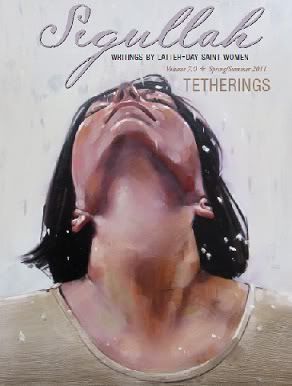
Okay. That's not true. The title is just an attention-grabbing lie. But there's this funny parallel I found between the latest issue of the the nonprofit LDS publication Segullah and the poster for the 2008 film adaptation of Scott Smith's horror novel, The Ruins.

Now, I kinda doubt the Segullah team had any idea this happened, but I think it is pretty awesome. Particularly since the latest issue of "writings by Latter-Day Saint women" is titled "Tetherings" and discusses issues of how we "forge and sever ties with people." An interesting topic; the articles could be worth reading.

The Ruins is also kind of about forging and severing (mostly severing), but instead of ties with people, it is more interested in cutting gross invasive evil out of your body. Perhaps the cutting in this example of exploitative soft-core torture-porn, where evil resides in remote Mexico (a logical place given America's well-reasoned fear of immigrants), is examining how we forge and sever ties with people, nature, and foreigners. "Get away from nature! it kills you!" "Get away from Mexico! it kills you!" Hmmm. It seems The Ruins is much more dire than Segullah. Didn't see that one coming. Unless the underlying message of this issue of Segullah is, "Get away from being an LDS woman! it kills you!" Based on Segullah's mission statement and from reading their blog, my guess is that isn't the message. But the visual parallel between these very contrasting media is very funny.

I'll have to pick up a copy of the new Segullah issue and put it next to my copy of Smith's book, which I'm gearing up to read sometime this summer.

Thursday, June 9, 2011

Calvino's Invisible Cities

Invisible CitiesInvisible Cities by Italo Calvino

My rating: 5 of 5 stars


Invisible Cities basically has everything I want from a postmodern novel. Its philosophical dream narrative is delightfully sophisticated, but lacks any pretension. Italo Calvino dismantles the 'real' world and notions of certainty and absolutism with great charm and sly precision. Calvino refrains from elevating himself over others, either through self-praise or by diminishing others. Through his whimsical descriptions of the fantastic cities populating the great Kahn's kingdom, Calvino acknowledges that the world is a big, complex place, where no two cities, cultures, or people are alike. Consequently, Marco Polo's examination and description of each city reveals that to require every city and people to follow the same system of imperfect rules, designed by people incapable of creating a perfect system, presents serious problems.

What most impresses me with Invisible Cities is how it pushes postmodernism without turning obnoxious, arrogant, lazy, mean, or stupid. Calvino's objective is not to destroy everything and declare there to be no god, no purpose, no center, and no reality. Instead, he seems to be amazed and delighted by the possibilities of a world unhinged from centralized, linear philosophy. He collapses time into one great now, wherein it becomes the individual's job to actualize their life and determine how they are to proceed. Truth becomes an elusive, tricky thing, but not absent from the world. If anything, Calivino seems to believe that our postmodern world creates more room for truth to exist, despite the bulk of mainstream thought (intellectual or otherwise) being saturated with over-determining half-truths and falsities. Finding personal truth becomes an obtainable challenge, where the first step is to recognize the limitations of our understanding, but to not then just throw in the towel and spout relativistic platitudes as over-determining as the allegedly irrelevant philosophies of past ages. To say nothing's real or true is just a lazy logical fallacy that Calvino avoids, which wins him big points with me. Instead, he writes one delightful piece of dream fantasy that is always smart and humorous, with a depth of feeling and compassion for humanity and the stumbling world we live in.

Lots of quotes I really like:

“The traveler roams all around and has nothing but doubts; he is unable to distinguish the features of the city, the features he keeps distinct in his mind also mingle.” (34)

“But why, then, does the city exist? What line separates the inside from the outside, the rumble of wheels from the howl of wolves?” (34)


“With cities, it is as with dreams: everything imaginable can be dreamed, but even the most unexpected dream is a rebus that conceals a desire or, its reverse, a fear. Cities, like dreams, are made of desires and fears, even if the thread of their discourse is secret, their rules are absurd, their perspectives deceitful, and everything conceals something else.” (44)


“There is no language without deceit.” (48)

“Polo: Perhaps all that is left of the world is a wasteland covered with rubbish heaps, and the hanging garden of the Great Khan’s palace. It is our eyelids that separate them, but we cannot know which is inside and which outside.” (104)

“Nobody wonders where, each day, they carry their load of refuse. Outside the city, surely; but each year the city expands, and street cleaners have to fall farther back. The bulk of the outflow increases and the piles rise higher, become stratified, extend over a wider perimeter.” (114-115)

“As the city is renewed each day, it preserves all of itself in its only definitive form: yesterday’s sweepings piled up on the sweepings of the day before yesterday and of all its days and years and decades.” (115)

“For those who pass it without entering, the city is one thing; it is another for those who are trapped by it and never leave.” (125)

“I speak and speak, but the listener retains only the words he is expecting.” (135)

“The inferno of the living is not something that will be; but if there is one, it is what is already here, the inferno where we live every day, that we form by being together. There are two ways to escape suffering it. The first is easy for many: accept the inferno and become such a part of it that you can no longer see it. The second is risky and demands constant vigilance and apprehension: seek and learn to recognize who and what, in the midst of the inferno, are not inferno, then make them endure, give them space.” (165)


Sunday, May 8, 2011

Remembering London

Next month it'll be two years since I was in London. It would seem rather cliche to say that the time has flown by and I can't believe it has already been that long. I guess cliches are appropriate sometimes.

For college students, summer provides the often much needed opportunity to get away from university and visit various parts of the world, either to study, vacation, live, work, or just disappear. This summer is no exception and many of my friends are vacating Utah County to spend their time elsewhere - Matt, and Lauran & Dustin are studying in Cambridge; Kylie is already doing her study abroad in Senegal; Talia will be working in China; Marshall & Beth have moved to San Francisco; Bentley is back in the English countryside; there are others I'm forgetting at the moment, too. Me, I'm staying here and am happy to be here. There's enough to do right in Utah that I'm happy to stay here and relax, though I'll soon be off for the Washington Peninsula with the family for a week.

Seeing new and/or familiar places is really cool and I really value the opportunities I've had to travel as much as I have. With all that travel I often get nostalgic for the places I've visited and the experiences I had there. It's just that nostalgia that has me writing this post. I went back through my London pictures and was reminded of how great the city was, even if I preferred the English countryside to the big city. After spending several weeks traipsing across the English countryside for my study abroad, the ten days we spent in London was quite a change of pace and tone. London reminded me just how beautiful, even spiritual, the weeks prior to our stay in the city really were. Hiking the stormy and windy mountains of Scotland and northern England, wandering across the haunted and lonely moors, laying on the grass at Tintagel listening to the ocean as the moon reflected off the water, and watching the sun set from Tennyson Downs  are just a few memorable moments of my time in the English countryside.

But London brought its own joys and overall was a very enjoyable experience. Much fun was had playing ultimate frisbee in their parks with really crappy grass; seeing really sweet plays like Death and the King's Horsemen and Arcadia; visiting the very impressive museums (the Soviet propaganda room of the Tate Modern was particularly awesome); and buying cheap CDs from street vendors on Portobello Road, then wandering the streets listening to Parts & Labor's Receivers. London has a charm that is all its own. It really is a unique place to England and to the world. Like Berlin (my favorite big city), it has an intriguing tone that is both modern and ancient. There is history there, but it's a city that has not lost touch with modern society, containing both positive and negative aspects of our day and age. It's a rather frantic city, but, if you're looking, you'll find ample opportunity to slow down and relax. All in all it's a place that I have fond memories of. But when you visit London, be sure to take some time, or a lot of time, and head for the countryside.

I could continue, but I'd rather just show some pictures and be done writing. The pictures are more interesting anyway.


Enjoy your travels.

Monday, March 28, 2011

The Gentle Hum of Anxiety

These shots were taken during my wilderness writing cross-country ski tour in the Uintas. This is us in the yurt on the first night.

"If I close my eyes I see your face and I'm not without you"

"It's not dark yet, but it's gettin there."
"If I go to sleep I'll never wake, I'll no longer exist."

Tuesday, March 15, 2011

Gustave Doré's London: A Pilgrimage

Dore's London: All 180 Illustrations from London, A Pilgrimage (Dover Pictorial Archive Series)Dore's London: All 180 Illustrations from London, A Pilgrimage by Gustave Doré

My rating: 4 of 5 stars


What's fun about Gustave Doré's London pictures is that they are a great historical document of London life and they also often serve as a nice commentary on the quality of life in London at this time. Doré was really fascinated by London, and it is apparent that he is interested in both the positive and negative aspects of the city. But while his images might includes a wide range of topics and personalities, it seems that Doré was most often drawn to the poor and working-class, and many of his images captures with striking potency the reality and plight of the lower-class.

I guess some contemporaries of Doré were bugged that Doré had so many pictures of the darker side of London - the poor, the homeless, the working and living conditions for London's lower-class. Maybe these dissenters were also bugged by the fact that it's these pictures of London's dark side that really stand out. The sections on London's more prosperous citizens and their leisure and social activities (like "The Race", "The Derby" and "London on the Downs") feel a bit weak and weren't that engaging to me. But Doré also knows how to laugh at those upper-class citizens, too. Picture 105 of the Monkey House in Zoological Garden is a pretty amusing jab at those proper ladies pressed to the cage wire looking at the monkeys. The ladies look more caged than the monkeys do and I wonder who Doré thought was the bigger ape of the two groups.

I also love that the final two images of the collection are "The Angel and the Orphan" and "Infant Hospital Patients." Both images recall the injustices and sorrows attached to children, because of the social and cultural practices of the times. Children were too often severely exploited and abused, and I like that this collection ends with the children in mind. "The Angel and the Orphan" shows the angel cradling an orphan child while knocking on a door. The image recalls Christ's words in Matthew 25:35, where he states "I was a stranger and ye took me in." Christ explains this statement in verse 40 to mean that "Inasmuch as ye have done it unto one of the least of these my brethren, ye have done it unto me." Thus, for a Christian community like London (or Doré's France), it is ones Christian obligation to care for and love ones neighbor. "The Angel and the Orphan" wraps up this nice collection by reminding a predominantly Christian population of their Christian obligation to their neighbors, and "Infant Hospital Patients" I think suggests that more can be done to "lift up the hands which hang down" (Heb 12:12). This was probably was not the message London's bourgeois culture wanted to hear. No wonder some people were bugged.

View all my reviews

Some images:

"Zoological Garden - The Monkey House"
"A Flower Girl"
"The Angel and the Orphan"
"Father Thames"