Showing posts with label Goodreads. Show all posts

Monday, August 8, 2011

The Face in the Lens: Anonymous Photographs - Robert Flynn Johnson

The Face in the Lens: Anonymous PhotographsThe Face in the Lens: Anonymous Photographs by Robert Flynn Johnson

My rating: 4 of 5 stars


Robert Flynn Johnson's collection of anonymous photographs makes the case that collecting anonymous photographs is as much an art (or at least a skill) as many of the photographs themselves. While many of these photos really do show artistic and technical skill, their potency is enhanced, or at least expanded, by their inclusion in this collection. Alone, many of these are fine photos, but together they create something even more fascinating - the collected comments and observations of photographers unknown, showing people now (mostly) passed away.

It is an odd feeling to be looking at a moment (staged or spontaneous) in a person's life, when you know that the subject of the photo as well as the photographer are now gone. It reminds me of Ossian Brown's brilliant collection Haunted Air, though in the case of The Face in the Lens the focus is much broader. But the feeling of looking into the past and seeing the photographic ghosts of anonymous people is somewhat eerie, but also intriguing. Photos say a lot, but they leave a lot up to the viewer, as Alexander McCall Smith's somewhat quirky introduction demonstrates. We're seeing history, but it's a history full of gaps, where we insert our own ideas and feelings from our perspective today. Johnson, through compiling these photos as he has, has created his own individual version of history, which is not bad, but is just the nature of telling history.

Part of the joy of this collection is in how varied the photos are and the noticeable lack of artistic aspiration in so many of them. Often the goal was simply to capture a significant moment for documentary, genealogical purposes rather than to do something artistic. What's cool is that sometimes both happened, which Johnson attributes to the nature of photography as an art reliant on technology - the camera can sometimes really help you out, even when you're totally ignorant of how to properly use it. Likewise, the subject of the photo can sometimes be as 'artful' in their body language and manner than any performer or model, suggesting that people really do have a natural impulse and feeling for what is aesthetically pleasing and/or what is genuine and real - this is true even in some of those stiff, posed photos where people were having to stand waiting forever while the picture was taken. Real life often presents the best performances you've ever seen.

Johnson has compiled a fine collection of anonymous photos and makes me wonder what he has in his collection that didn't make the cut for this book. What pictures does he have that still remain unknown to people and what pictures are floating around out there yet to be uncovered? I start feeling a tad weird thinking about my own photos being collected like this. What stories would people create about my photos? What would that say about the subject and what would it say about me? And what about you?

View all my reviews

Wednesday, July 13, 2011

Pornland: How Porn Has Hijacked our Sexuality - Gail Dines

Pornland: How Porn Has Hijacked our SexualityPornland: How Porn Has Hijacked our Sexuality by Gail Dines

My rating: 4 of 5 stars


Gail Dines’ Pornland is the first book I’ve read about pornography and I think it was an excellent place to start. Using very clear language and thought-provoking analysis, Dines breaks down porn in ways that I found convincing and accurate. Admittedly, my personal layperson thoughts about porn and its effects on popular culture, business, sexuality, race and gender were often quite similar to Dines’, though obviously in a less-informed, critically organized and researched form. Pornland has confirmed and expanded my own thoughts and concerns about pornography, which I guess makes me a biased reader inclined to read her book with less critical rigor than I should. But I didn’t read this for a class or to become a pornography scholar; I read it as a thoughtful, concerned citizen who believes pornography might best represent everything wrong with modern society.

Dines’ historical account of when porn was first brought into the mainstream via Playboy, Penthouse, and Hustler illuminates how the porn industry operated then and now first and foremost as a business intent on making the highest profits possible. As a business, it represents everything wrong with capitalistic business practice, for it focuses solely on profit margins at the expense of people – profits supersede the interests (health, safety, well-being, etc.) of both the consumer (mostly men) and the employees (female performers). They are selling an industrially manufactured product from the assembly line, where churning out as many units as possible is the order of the day. This mass-production method debases people and sexuality, reducing them to mere objects and mechanics. No deeper social, emotional, psychological, or spiritual connection is desired.

According to Dines, the industry works really hard to sell its product and garner customers. How porn is advertised to the public is crafty indeed. Playboy capitalizes on their sleek, debonair approach, which has served Hugh Hefner quite well. The sleazy humor used by Hustler claims porn consumers are greasy white trash when in fact their main consumer isn’t that at all; nor is founder (and millionaire) Larry Flynt. When it does portray itself as a prosperous celebrity occupation, as with porn star Jenna Jameson, it conveniently omits any indication that being a porn star is actually a terribly miserable occupation. Porn survives, like so much of consumer business today, by advertising their product in an intentionally deceptive package – basically, they lie to us. Since people are always influenced by the culture in which they live, it is no wonder we begin listening to and believing porn’s messages, which come in all forms: Cosmopolitan and Maxim magazines, child clothing lines designed to make prepubescent girls “hot” and “sexy,” Carl’s Jr. ads containing messages so sexually explicit you wonder if food even entered the advertisers’ minds, or music videos of scantily-clad divas writhing around in some form of orgasmic ecstasy. These are a few examples of how porn has seeped into our culture. Sex sells, and porn has taken full advantage of this fact, with their primary objective being money and rabid consumerism.

21st century consumerism has reached terminal levels of gluttony, with porn being one of the grossest transgressors and supporters of rabid consumption. The point of the product is to get you to consume more and more, and with pornography addiction numbers piling up it seems that the industry has been wildly successful. What Dines successfully shows is how the harsh treatment of women, the open and unapologetic racism, pseudo-child porn’s manipulation of women to look younger, to name but three, all show that pornography, in a very real and rather literal way, consumes people. People are the product and while these raw materials are abundantly available, due to their savage exploitation their shelf life is very short.

Dines’ descriptions are vivid and explicit, pulling few punches as to the aggressive, racist, sexist, sadistic aspects of the industry. She also doesn’t avoid naming large corporations benefiting from porn – amazon.com & google.com are getting quite a bump from searches and sales; hotel chains like Marriott and Holiday Inn generate quite a sum from providing porno movies. And Dines points out the flaws in arguments that porn isn’t so bad because it can’t be proven that watching porn causes men to rape women – like rape is the only crime against women worth caring about. She is (rightfully) an unapologetic feminist who argues that feminism is about gender equality, which is completely absent in porno movies, and that so-called female sexual liberation celebrated by Cosmopolitan and Sex and the City is actually about pleasing and being subservient to men – something that would make those second waves feminists who fought for sexual liberation roll over in their graves.

Dines’ arguments and analysis show contemporary society to have reduced sex to nothing but the physical appearance and performance, with the brunt of the pressure and pain put to women, though men are obviously damaged by this reductive view as well. I'll add that this is true at my own university, BYU, which claims and at least appears to not have a porn or promiscuous sex problem to the degree of other universities, which is not to say there isn’t a problem – there is, but hopefully to a lesser degree than elsewhere. BYU has (unacknowledged) problems with sexist attitudes and beliefs that exist within the porn industry in more radical form. But women still aren’t spared the suffocating pressure to be physically attractive – the hot and sexy factor is still a huge determinant in whether a woman gets dates and is accepted into male circles. Women constantly have to live up to the expectations of the men (and strangely the expectations of other women) around them, which naturally leads to the problems Dines addresses: eating disorders, unnecessary plastic surgery, excessive exercise, depression, poor grades and general feelings of inadequacy.

In conclusion (“finally!” you exclaim), Pornland is an excellent read. My only wishes were that the book’s conclusion discussed solutions to combating pornography in more detail. As it was, the conclusion was mostly an advert for the group Stop Porn Culture, which she helped found. And I had wished for some discussion about what she felt a healthy sexual relationship entailed – the book after all is about “how porn has hijacked our sexuality.” Aside from brief statements about sex being wonderfully important for strengthening a couple’s relationship, there is no in depth assertions of what couples can do to have a healthy, porn-free relationship. People need positive reasons to pursue the type of relationship I believe Dines wishes people to have. Identifying and proving that porn isn’t good for us is an important message, and she does it really well, but some encouragement on the other end would have made this already good book that much better. But as it is, this is a fine examination and condemnation of pornography.

View all my reviews

Thursday, June 9, 2011

Calvino's Invisible Cities

Invisible CitiesInvisible Cities by Italo Calvino

My rating: 5 of 5 stars


Invisible Cities basically has everything I want from a postmodern novel. Its philosophical dream narrative is delightfully sophisticated, but lacks any pretension. Italo Calvino dismantles the 'real' world and notions of certainty and absolutism with great charm and sly precision. Calvino refrains from elevating himself over others, either through self-praise or by diminishing others. Through his whimsical descriptions of the fantastic cities populating the great Kahn's kingdom, Calvino acknowledges that the world is a big, complex place, where no two cities, cultures, or people are alike. Consequently, Marco Polo's examination and description of each city reveals that to require every city and people to follow the same system of imperfect rules, designed by people incapable of creating a perfect system, presents serious problems.

What most impresses me with Invisible Cities is how it pushes postmodernism without turning obnoxious, arrogant, lazy, mean, or stupid. Calvino's objective is not to destroy everything and declare there to be no god, no purpose, no center, and no reality. Instead, he seems to be amazed and delighted by the possibilities of a world unhinged from centralized, linear philosophy. He collapses time into one great now, wherein it becomes the individual's job to actualize their life and determine how they are to proceed. Truth becomes an elusive, tricky thing, but not absent from the world. If anything, Calivino seems to believe that our postmodern world creates more room for truth to exist, despite the bulk of mainstream thought (intellectual or otherwise) being saturated with over-determining half-truths and falsities. Finding personal truth becomes an obtainable challenge, where the first step is to recognize the limitations of our understanding, but to not then just throw in the towel and spout relativistic platitudes as over-determining as the allegedly irrelevant philosophies of past ages. To say nothing's real or true is just a lazy logical fallacy that Calvino avoids, which wins him big points with me. Instead, he writes one delightful piece of dream fantasy that is always smart and humorous, with a depth of feeling and compassion for humanity and the stumbling world we live in.

Lots of quotes I really like:

“The traveler roams all around and has nothing but doubts; he is unable to distinguish the features of the city, the features he keeps distinct in his mind also mingle.” (34)

“But why, then, does the city exist? What line separates the inside from the outside, the rumble of wheels from the howl of wolves?” (34)


“With cities, it is as with dreams: everything imaginable can be dreamed, but even the most unexpected dream is a rebus that conceals a desire or, its reverse, a fear. Cities, like dreams, are made of desires and fears, even if the thread of their discourse is secret, their rules are absurd, their perspectives deceitful, and everything conceals something else.” (44)


“There is no language without deceit.” (48)

“Polo: Perhaps all that is left of the world is a wasteland covered with rubbish heaps, and the hanging garden of the Great Khan’s palace. It is our eyelids that separate them, but we cannot know which is inside and which outside.” (104)

“Nobody wonders where, each day, they carry their load of refuse. Outside the city, surely; but each year the city expands, and street cleaners have to fall farther back. The bulk of the outflow increases and the piles rise higher, become stratified, extend over a wider perimeter.” (114-115)

“As the city is renewed each day, it preserves all of itself in its only definitive form: yesterday’s sweepings piled up on the sweepings of the day before yesterday and of all its days and years and decades.” (115)

“For those who pass it without entering, the city is one thing; it is another for those who are trapped by it and never leave.” (125)

“I speak and speak, but the listener retains only the words he is expecting.” (135)

“The inferno of the living is not something that will be; but if there is one, it is what is already here, the inferno where we live every day, that we form by being together. There are two ways to escape suffering it. The first is easy for many: accept the inferno and become such a part of it that you can no longer see it. The second is risky and demands constant vigilance and apprehension: seek and learn to recognize who and what, in the midst of the inferno, are not inferno, then make them endure, give them space.” (165)


Tuesday, March 15, 2011

Gustave Doré's London: A Pilgrimage

Dore's London: All 180 Illustrations from London, A Pilgrimage (Dover Pictorial Archive Series)Dore's London: All 180 Illustrations from London, A Pilgrimage by Gustave Doré

My rating: 4 of 5 stars


What's fun about Gustave Doré's London pictures is that they are a great historical document of London life and they also often serve as a nice commentary on the quality of life in London at this time. Doré was really fascinated by London, and it is apparent that he is interested in both the positive and negative aspects of the city. But while his images might includes a wide range of topics and personalities, it seems that Doré was most often drawn to the poor and working-class, and many of his images captures with striking potency the reality and plight of the lower-class.

I guess some contemporaries of Doré were bugged that Doré had so many pictures of the darker side of London - the poor, the homeless, the working and living conditions for London's lower-class. Maybe these dissenters were also bugged by the fact that it's these pictures of London's dark side that really stand out. The sections on London's more prosperous citizens and their leisure and social activities (like "The Race", "The Derby" and "London on the Downs") feel a bit weak and weren't that engaging to me. But Doré also knows how to laugh at those upper-class citizens, too. Picture 105 of the Monkey House in Zoological Garden is a pretty amusing jab at those proper ladies pressed to the cage wire looking at the monkeys. The ladies look more caged than the monkeys do and I wonder who Doré thought was the bigger ape of the two groups.

I also love that the final two images of the collection are "The Angel and the Orphan" and "Infant Hospital Patients." Both images recall the injustices and sorrows attached to children, because of the social and cultural practices of the times. Children were too often severely exploited and abused, and I like that this collection ends with the children in mind. "The Angel and the Orphan" shows the angel cradling an orphan child while knocking on a door. The image recalls Christ's words in Matthew 25:35, where he states "I was a stranger and ye took me in." Christ explains this statement in verse 40 to mean that "Inasmuch as ye have done it unto one of the least of these my brethren, ye have done it unto me." Thus, for a Christian community like London (or Doré's France), it is ones Christian obligation to care for and love ones neighbor. "The Angel and the Orphan" wraps up this nice collection by reminding a predominantly Christian population of their Christian obligation to their neighbors, and "Infant Hospital Patients" I think suggests that more can be done to "lift up the hands which hang down" (Heb 12:12). This was probably was not the message London's bourgeois culture wanted to hear. No wonder some people were bugged.

View all my reviews

Some images:

"Zoological Garden - The Monkey House"
"A Flower Girl"
"The Angel and the Orphan"
"Father Thames"

Monday, October 4, 2010

Doré's Dragons, Demons and Monsters

Dore's Dragons, Demons and Monsters (Dover Pictorial Archive Series)Dore's Dragons, Demons and Monsters by Gustave Doré

My rating: 5 of 5 stars


Gustave Doré is pretty awesome. Few artists' works embed themselves in my mind the way Doré's do. I think seeing his illustrations to works like Paradise Lost, Don Quixote, and The Divine Comedy have excited me to eventually read those stories more than all the talk surrounding these works that I've heard in my English classes. That might mean I'm just a lazy reader, or it might have something to do with the long tradition of illustrations accompanying literary works. These days, it feels to me like such a fusion of the arts is less encouraged, even looked down upon. "Serious" literature doesn't bother with pictures, but is all wrapped up in the magnificence of language (except who's gonna say that Paradise Lost isn't serious literature, or an example of weak language?). Should I blame the modernists who brought us formalism for that? Probably not. In any case, it seems like outside of the (now overly popular and rather bloated) graphic novel, and the (unfairly overlooked) picture & pop-up book, that pictures have been snubbed out of literature. Some might say it's because visual arts have somehow found their way into literary language itself, and that there just isn't a need for it, because some writers adopt a cinematic, visual style anyway. I guess you can argue that such a thing as cinematic language exists, but I think there's room for a counter-argument as well - language has always had a visual or cinematic quality in the hands of the right people. (Now I'm just rambling.) Basically, Doré is pretty fabulous, and we should still read books with pictures.

This modest collection of illustrations from Dover is a great introduction to Doré's work. It's a really good highlight reel, that gives to a solid taste for what he's doing. There are no essays accompanying these illustrations, which might be a bummer to those of us who like reading such things, but it's also really cool to have only the illustrations, standing on their own merits. The illustrations are strong enough on their own that explanation as to why they're so great seems extraneous. (Which might mean this review is irrelevant - just a sign of my own pretentiousness. Fair enough.) Essay and critical work on these pictures is cool, but unnecessary for this particular edition. If I want a more extensive analysis and collection of Doré's works, I'll be able to find them, but this book gives me a satisfying first taste.

The illustrations contained here have a spiritual, mystical, mythical quality that carries them beyond simple depictions of demons and monsters. Horror and the grotesque are here in abundance, but serve as a reminder that there are many things in the world that are much bigger than us and are beyond rational comprehension. Sometimes these things present a very real danger to us, but it doesn't always have to turn out like that. Some of these demons and monsters look rather humorous, and are likely meant to, which makes me think that not everything that appears to be an evil demon always is. And in any case, while the horrors of the rational or irrational world might surround us, this also doesn't mean we will be destroyed by them. Many of the works Doré was illustrating didn't end in the complete destruction of humanity - quite the opposite. So there seems to be a kind of inverted optimism or positivity to the pictures that I find really fantastic.

If this is an artistic style you like, then I'd really recommend checking out this book. If it isn't your style, maybe give it another chance before moving on to your already accepted preferences.

View all my reviews

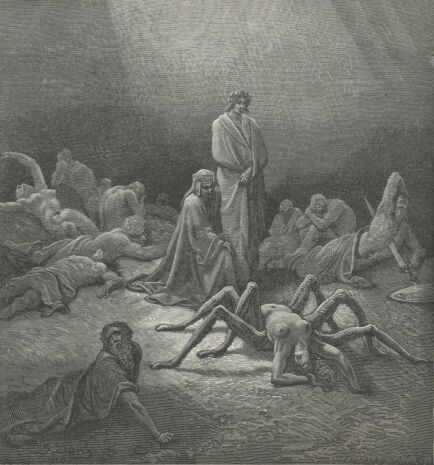
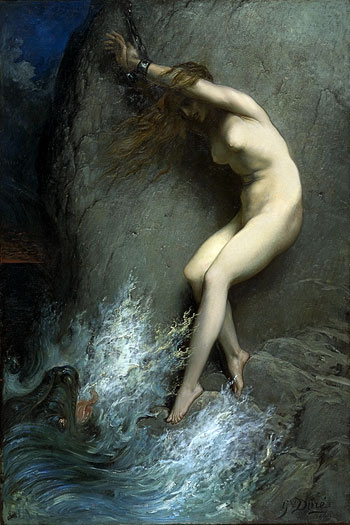
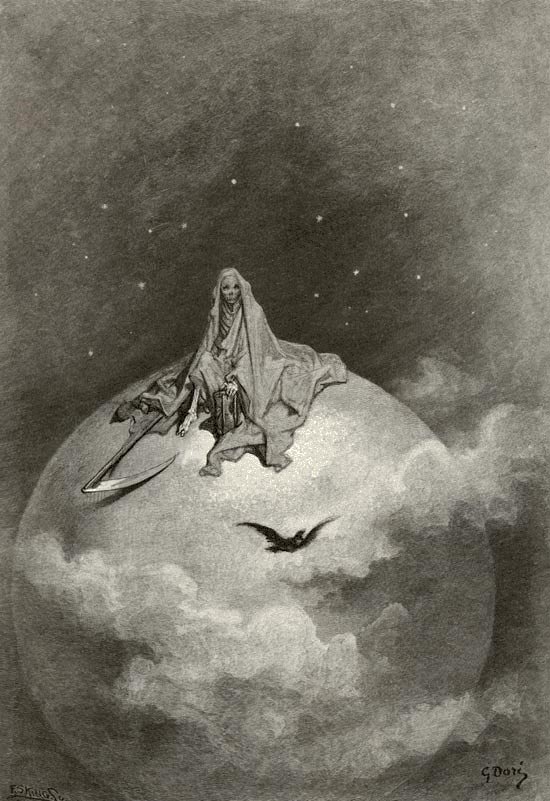
In case you've never seen a Gustave Doré illustration before, here are a couple examples of the coolness:

Arachne

Andromeda
From Edgar Allen Poe's "The Raven"

Saturday, October 2, 2010

Berlin: a book, a review, and some pictures.

Berlin (Photopocket City)Berlin by Stefan Dauth

My rating: 4 of 5 stars


This book is a wonderful collection of black and white photographs of my favorite city. I felt that this book captured the multitude of personalities, tones, histories, and cultures that make Berlin the fascinating city that it is and has been for at least the last century. Major city landmarks like Berliner Dom, Brandenburger Tor, the Reichstag, and such are all here, but there are also the great pictures of the alley way at Hackesche Hoefe (where you'll always find great graffiti art) and the street book market in from of the Humboldt Universitaet. You also get a good look at some of the people and fashion that populates the city. I like that the while you have the glamorous shots from down at Potsdamer Platz, you also have the less glamorous shots of anarchy symbols painted on walls and peeling, shredded poster ads pasted on the walls advertising concerts, protests and whatever else. A good collection that uses nice camera work to give an interesting portrait of a very vibrant, historical, and modern city.

View all my reviews

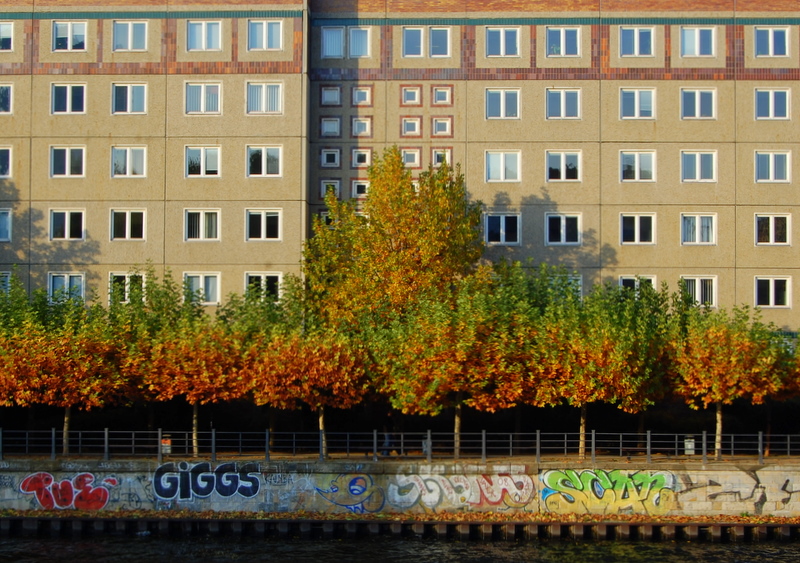
Looking at Dauth's photographs got me all nostalgic for Berlin and I felt like adding some of my own pictures that I took last fall when I was there doing a research project.

Renovations in the Alley at Hackesche Hoefe

Observing the Dead

Modern Times

Fall in the City

Friday, August 27, 2010

Then There Were None

  Then There Were NoneThen There Were None by Martha H. Noyes

My rating: 5 of 5 stars


Then There Were None is a perfectly structured book; it knows what it wants to do, and executes it through a remarkable balance of photographs, quotes, poems, and historical information. This is a quick, concise, and substantial little book that packs one solid punch.

Elizabeth Kapu'uwailani Lindsey Buyers states in the book's forward that the book "is not a tale of blame or vicitmization." Well, it doesn't need to be. The devastation of the Hawaiian people and their culture hardly needs to be told through finger-pointing and victimization. Simply recounting the history and showing their culture is enough, as this book proves.

I also quite like the preface, which asks:

"Has any history text, however objective, quelled the troubles between [warring cultures]?

No, because history isn't what divides them. what fuels the division is emotion.

It is an emotional voice we wanted to offer. If the heart's wounds, the spirit's ache are laid bare, healing balm can reach the injury and ease the pain."

It makes a lot of sense to me. The book does elicit an emotional response, but through a controlled, leveled presentation that doesn't seem negatively manipulative or entrenched in hateful bitterness. Any anger I felt while reading this book is a product of my own rash behavior and not the wishes of the author.

The archival photos are effective both as visual documentation as well as additional narration. They aren't extraneous, but rather work in tandem with the text, using photography's strengths to enhance the narrative beyond what text can do. Since Martha H. Noyes first told this story through a documentary film of the same title, the skillful use of photos comes as no surprise.

What a lovely little book. The cover photo is excellent, the size is great, the length is just right, and the information is substantial throughout. A sad, but wonderful little book.

View all my reviews >>