Showing posts with label Literature. Show all posts

Monday, November 7, 2011

Thoughts about and from Čapek's The Absolute at Large

Looking for some fun speculative sci-fi satire? I recommend Czech writer, Karel Čapek's The Absolute at Large (1922). I finished reading this after watching (again) Stanley Kubrick's 2001: A Space Odyssey (1968) and Andrei Tarkovsky's Solaris (1972). This is a more fitting combination than it might sound. I think we often consider sci-fi to be about science, or, as Susan Sontag claimed, about disaster. But what all three of these examples show is how sci-fi also spends a lot of time thinking about religion, spirituality, and god/God. All three approach this subject differently and each to great effect. Čapek's approach is more humorous and satirical, but that doesn't diminish the potency of his point, rather it enhances it. For Čapek, the human debate about deity and the demand for absolute truth is rather ridiculous, not because God is dumb, but because our approach to and conception of deity is absurd, as is our insistence that everyone conform to our conception of the Divine (the Absolute). The problem of religion has little to do with religion and more to do with people. In the end, Čapek blasts humanity and its institutions way more than he does religion.

Here are a few passages I found especially great:

It is a foible of our human nature that when we have an extremely unpleasant experience, it gives us a peculiar satisfaction if it is “the biggest” of its disagreeable kind that has happened since the world began. During a heat wave, for instance, we are very pleased if the papers announce that it is “the highest temperature reached since the year 1881,” and we feel a little resentment towards the year 1881 for having gone us one better. Or if our ears are frozen till all the skin peels off, it fills us with a certain happiness to learn that “it was the hardest frost recorded since 1786.” It is just the same with wars. The war in progress is either the most righteous or the bloodiest, or the most successful, or the longest, since such and such a time; any superlative whatever always affords us the proud satisfaction of having been through something extraordinary and record-breaking.
--
                “Look, here, sir,” he [Captain Trouble] said after a while, “what are they squabbling about over there, anyway? Some boundary or other?”
                “Less than that.”
                “Colonies?”
                “Even less than that.”
                “Commercial treaties?”
                "No. Only about the truth.”
                “What kind of truth?”
                “The absolute truth. You see, every nation insists that it has the absolute truth.”
                “Hm,” grunted the Captain. “What is it, anyway?”
                “Nothing. A sort of human passion. You’ve heard, haven’t you, that in Europe yonder, and everywhere in fact, a . . . a God, you know . . . came into the world.”
                "Yes. I did hear that.”
                “Well, that’s what it’s all about, don’t you understand?”
                “No, I don’t understand, old man. If you ask me, the true God would put things right in the world. The one they’ve got can’t be the true and proper God.”
                “On the contrary,” said G.H. Bondy (obviously pleased at being able to talk for once with an independent and experienced human being), “I assure you that it is the true God. But I’ll tell you something else. This true God is far too big.”
                “Do you think so?”
                “I do indeed. He is infinite. That’s just where the trouble lies. You see, everyone measures off a certain amount of Him and then thinks it is the entire God. Each one appropriates a little fringe or fragment of Him and then thinks he possesses the whole of Him. See?”
                “Aha,” said the Captain. “And then gets angry with everyone else who has a different bit of Him.”
                “Exactly. In order to convince himself that God is wholly his, he has to go and kill all the others. Just for that very reason, because it means so much to him to have the whole of God and the whole of the truth. That’s why he can’t bear anyone else to have any other God or any other truth. If he once allowed that, he would have to admit that he himself has only a few wretched metres or gallons or sack-loads of divine truth. You see, suppose Dash were convinced that it was tremendously important that only Dash’s underwear should be the best on the earth, he would have to burn his rival, Blank, and all Blank’s underwear. But Dash isn’t so silly as that in the matter of underwear; he is only as silly as that in the matter of religion or English politics. If he believed that God was something as substantial and essential as underwear, he would allow other people to provide themselves with Him just as they pleased. But he hasn’t sufficient commercial confidence in Him; and so he forces Dash’s God or Dash’s Truth on everybody with curses, wars and other unreliable forms of advertisement. I am a business man and I understand competition."
--
“Everyone believes in his own superior God, but he doesn’t believe in another man, or credit him with believing in something good. People should first of all believe in other people, and the rest would soon follow.”
-- 
“A man may certainly think that another religion is a bad one, but he oughtn’t to think that the man who follows it is a low, vile, and treacherous person. And the same applies to politics and everything.”
I'd also recommend reading Čapek's brilliant play R.U.R. - Rossum's Universal Robots (1920). I first read it in my high school sci-fi class and only recently rediscovered and reread it. I loved it in high school and love it more now.

Enjoy yourselves some sci-fi!

Saturday, June 11, 2011

Your Life as a Mormon Woman is an Exploitative Horror Film

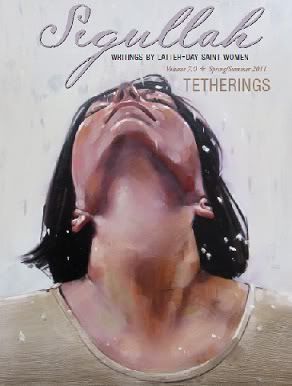
Okay. That's not true. The title is just an attention-grabbing lie. But there's this funny parallel I found between the latest issue of the the nonprofit LDS publication Segullah and the poster for the 2008 film adaptation of Scott Smith's horror novel, The Ruins.

Now, I kinda doubt the Segullah team had any idea this happened, but I think it is pretty awesome. Particularly since the latest issue of "writings by Latter-Day Saint women" is titled "Tetherings" and discusses issues of how we "forge and sever ties with people." An interesting topic; the articles could be worth reading.

The Ruins is also kind of about forging and severing (mostly severing), but instead of ties with people, it is more interested in cutting gross invasive evil out of your body. Perhaps the cutting in this example of exploitative soft-core torture-porn, where evil resides in remote Mexico (a logical place given America's well-reasoned fear of immigrants), is examining how we forge and sever ties with people, nature, and foreigners. "Get away from nature! it kills you!" "Get away from Mexico! it kills you!" Hmmm. It seems The Ruins is much more dire than Segullah. Didn't see that one coming. Unless the underlying message of this issue of Segullah is, "Get away from being an LDS woman! it kills you!" Based on Segullah's mission statement and from reading their blog, my guess is that isn't the message. But the visual parallel between these very contrasting media is very funny.

I'll have to pick up a copy of the new Segullah issue and put it next to my copy of Smith's book, which I'm gearing up to read sometime this summer.

Thursday, June 9, 2011

Calvino's Invisible Cities

Invisible CitiesInvisible Cities by Italo Calvino

My rating: 5 of 5 stars


Invisible Cities basically has everything I want from a postmodern novel. Its philosophical dream narrative is delightfully sophisticated, but lacks any pretension. Italo Calvino dismantles the 'real' world and notions of certainty and absolutism with great charm and sly precision. Calvino refrains from elevating himself over others, either through self-praise or by diminishing others. Through his whimsical descriptions of the fantastic cities populating the great Kahn's kingdom, Calvino acknowledges that the world is a big, complex place, where no two cities, cultures, or people are alike. Consequently, Marco Polo's examination and description of each city reveals that to require every city and people to follow the same system of imperfect rules, designed by people incapable of creating a perfect system, presents serious problems.

What most impresses me with Invisible Cities is how it pushes postmodernism without turning obnoxious, arrogant, lazy, mean, or stupid. Calvino's objective is not to destroy everything and declare there to be no god, no purpose, no center, and no reality. Instead, he seems to be amazed and delighted by the possibilities of a world unhinged from centralized, linear philosophy. He collapses time into one great now, wherein it becomes the individual's job to actualize their life and determine how they are to proceed. Truth becomes an elusive, tricky thing, but not absent from the world. If anything, Calivino seems to believe that our postmodern world creates more room for truth to exist, despite the bulk of mainstream thought (intellectual or otherwise) being saturated with over-determining half-truths and falsities. Finding personal truth becomes an obtainable challenge, where the first step is to recognize the limitations of our understanding, but to not then just throw in the towel and spout relativistic platitudes as over-determining as the allegedly irrelevant philosophies of past ages. To say nothing's real or true is just a lazy logical fallacy that Calvino avoids, which wins him big points with me. Instead, he writes one delightful piece of dream fantasy that is always smart and humorous, with a depth of feeling and compassion for humanity and the stumbling world we live in.

Lots of quotes I really like:

“The traveler roams all around and has nothing but doubts; he is unable to distinguish the features of the city, the features he keeps distinct in his mind also mingle.” (34)

“But why, then, does the city exist? What line separates the inside from the outside, the rumble of wheels from the howl of wolves?” (34)


“With cities, it is as with dreams: everything imaginable can be dreamed, but even the most unexpected dream is a rebus that conceals a desire or, its reverse, a fear. Cities, like dreams, are made of desires and fears, even if the thread of their discourse is secret, their rules are absurd, their perspectives deceitful, and everything conceals something else.” (44)


“There is no language without deceit.” (48)

“Polo: Perhaps all that is left of the world is a wasteland covered with rubbish heaps, and the hanging garden of the Great Khan’s palace. It is our eyelids that separate them, but we cannot know which is inside and which outside.” (104)

“Nobody wonders where, each day, they carry their load of refuse. Outside the city, surely; but each year the city expands, and street cleaners have to fall farther back. The bulk of the outflow increases and the piles rise higher, become stratified, extend over a wider perimeter.” (114-115)

“As the city is renewed each day, it preserves all of itself in its only definitive form: yesterday’s sweepings piled up on the sweepings of the day before yesterday and of all its days and years and decades.” (115)

“For those who pass it without entering, the city is one thing; it is another for those who are trapped by it and never leave.” (125)

“I speak and speak, but the listener retains only the words he is expecting.” (135)

“The inferno of the living is not something that will be; but if there is one, it is what is already here, the inferno where we live every day, that we form by being together. There are two ways to escape suffering it. The first is easy for many: accept the inferno and become such a part of it that you can no longer see it. The second is risky and demands constant vigilance and apprehension: seek and learn to recognize who and what, in the midst of the inferno, are not inferno, then make them endure, give them space.” (165)


Wednesday, November 17, 2010

Gustav Doré is Awesome. Hell is Not.

Gustav Doré's horrific depiction of the Ninth Circle of Hell, from Dante's Inferno, where sinners are frozen in ice.

Monday, October 4, 2010

Doré's Dragons, Demons and Monsters

Dore's Dragons, Demons and Monsters (Dover Pictorial Archive Series)Dore's Dragons, Demons and Monsters by Gustave Doré

My rating: 5 of 5 stars


Gustave Doré is pretty awesome. Few artists' works embed themselves in my mind the way Doré's do. I think seeing his illustrations to works like Paradise Lost, Don Quixote, and The Divine Comedy have excited me to eventually read those stories more than all the talk surrounding these works that I've heard in my English classes. That might mean I'm just a lazy reader, or it might have something to do with the long tradition of illustrations accompanying literary works. These days, it feels to me like such a fusion of the arts is less encouraged, even looked down upon. "Serious" literature doesn't bother with pictures, but is all wrapped up in the magnificence of language (except who's gonna say that Paradise Lost isn't serious literature, or an example of weak language?). Should I blame the modernists who brought us formalism for that? Probably not. In any case, it seems like outside of the (now overly popular and rather bloated) graphic novel, and the (unfairly overlooked) picture & pop-up book, that pictures have been snubbed out of literature. Some might say it's because visual arts have somehow found their way into literary language itself, and that there just isn't a need for it, because some writers adopt a cinematic, visual style anyway. I guess you can argue that such a thing as cinematic language exists, but I think there's room for a counter-argument as well - language has always had a visual or cinematic quality in the hands of the right people. (Now I'm just rambling.) Basically, Doré is pretty fabulous, and we should still read books with pictures.

This modest collection of illustrations from Dover is a great introduction to Doré's work. It's a really good highlight reel, that gives to a solid taste for what he's doing. There are no essays accompanying these illustrations, which might be a bummer to those of us who like reading such things, but it's also really cool to have only the illustrations, standing on their own merits. The illustrations are strong enough on their own that explanation as to why they're so great seems extraneous. (Which might mean this review is irrelevant - just a sign of my own pretentiousness. Fair enough.) Essay and critical work on these pictures is cool, but unnecessary for this particular edition. If I want a more extensive analysis and collection of Doré's works, I'll be able to find them, but this book gives me a satisfying first taste.

The illustrations contained here have a spiritual, mystical, mythical quality that carries them beyond simple depictions of demons and monsters. Horror and the grotesque are here in abundance, but serve as a reminder that there are many things in the world that are much bigger than us and are beyond rational comprehension. Sometimes these things present a very real danger to us, but it doesn't always have to turn out like that. Some of these demons and monsters look rather humorous, and are likely meant to, which makes me think that not everything that appears to be an evil demon always is. And in any case, while the horrors of the rational or irrational world might surround us, this also doesn't mean we will be destroyed by them. Many of the works Doré was illustrating didn't end in the complete destruction of humanity - quite the opposite. So there seems to be a kind of inverted optimism or positivity to the pictures that I find really fantastic.

If this is an artistic style you like, then I'd really recommend checking out this book. If it isn't your style, maybe give it another chance before moving on to your already accepted preferences.

View all my reviews

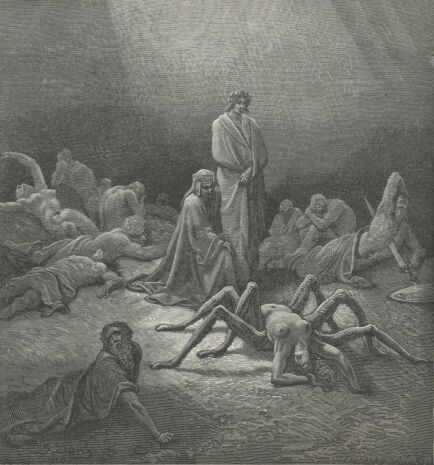
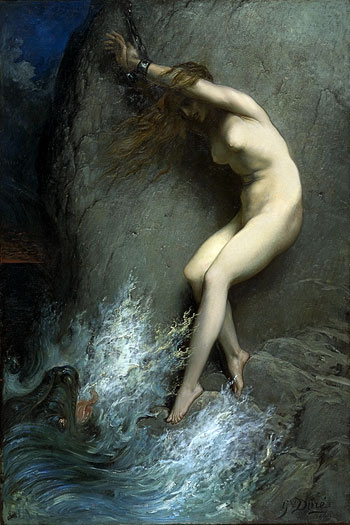
In case you've never seen a Gustave Doré illustration before, here are a couple examples of the coolness:

Arachne

Andromeda
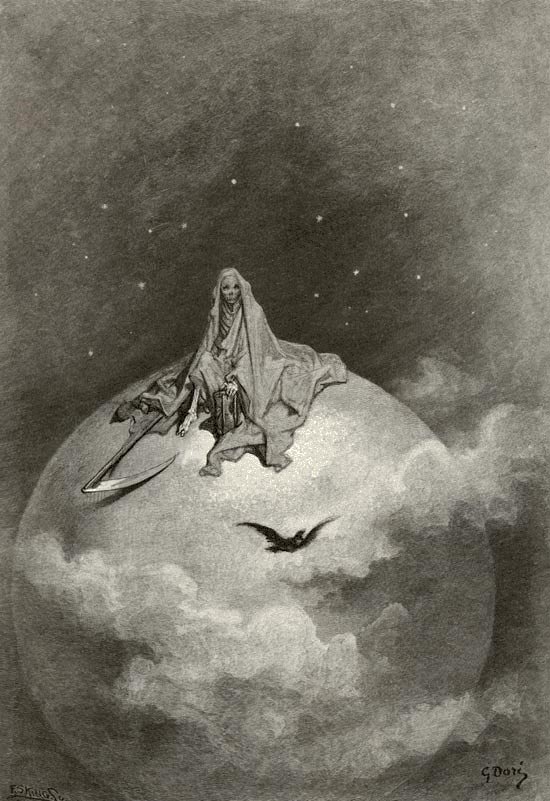
From Edgar Allen Poe's "The Raven"

Saturday, September 25, 2010

What you wish your research was

I'll bet all you college kids out there wish your research was as cool as mine. Well, keep wishing, because real fun topics like this don't come to just anyone. Last week my African-American Literature class finished reading Richard Wright's impressive novel, Native Son. How Wright used movies, newspapers, and spectatorship was interesting to me and I decided it would be a good paper topic. This led me to this book:

Take special note of how smiley those people are; they're just out having a real good time, I guess. Oh, and then there's this one:

This is the book for the "Without Sanctuary" photo exhibit that made some waves a few years back. This book leaves quite an impression.

America, sometimes you really treat your people like crap.

Sunday, August 29, 2010

Summer Reading 2010

Now that summer has passed and those of us (un)fortunate to be taking classes begin another semester, I thought I'd spotlight a few of my summer reads. It'll be like watching the Emmy's, but a lot less interesting.

I like to think that summer reading is a time to catch up on all those fine things we couldn't read while taking those stuffy university courses where only the serious stuff got read. With summer, we can (perhaps only temporarily) set aside the serious reading, let our hair down, put our feet up and lounge in the bathrobe, enjoying a light read. Leisure reading isn't supposed to be hard, after all. If the point was to think, we'd stay in classes. No, summer is a time for "something I can ignore." But sometimes this weird thing happens where I just can't let the serious stuff go. Basically, I'm often still too uptight and humorless to indulge exclusively in the light and fluffy stuff. And then there are times when words are too hard and I just want pictures - for that there are photography books to look at and admire, though I know nothing about photography. I guess summer allows for anything. Whatever your taste, summer is a time of personal indulgence - at least, it is for me, since I still live at home and avoid any real responsibilities.

Because I'm a geek, I have a list of everything I read this summer, to give a little context to the selections below. There were several nice reads, but only five will receive special recognition here. The winners are:

BEST PICTURES: Ordinary Lives - Rania Matar

Rania Matar's photos of contemporary Lebanon and the people who live there are some of the coolest shots of modern Islamic culture that I've yet seen. These portraits of Muslim women (and some men) living their lives in the bombed out, war-torn cities of Lebanon are hardly the images you find on Fox News - most of Fox's viewers don't know where Lebanon is anyway. Ordinary Lives shows something that, when you think about it, should be quite obvious: the ordinary citizens of Middle Eastern countries like Lebanon are living their lives, in the same general manner that anyone does; you work, have a family, have fun together, go shopping, go to church, listen to iPods, and anything else that the average person might do. But these ordinary lives are living amidst piles of rubble and destroyed, yet still occupied, buildings. Her photos always seem display more than one possible story, which is a helpful reminder to those of us (meaning all of us) who are prone to forget that life and people are complicated. They contain more than one story and deserve to be seen and treated as human beings rather than as just faces in the crowd, or worse, collateral damage.

BEST MUSICAL ACCOMPANIMENT: The Wilco Book - Wilco & Dan Nadal

What's better than a book with soundtrack included? The Wilco Book is an example to all books about artists and bands in how to really please your audience (or just to get them to buy your book): Include a disc of otherwise unavailable material. This doesn't seem like such a bad move since some musicians (i.e. Elvis Costello) have made claims that there's nothing more useless than writing about music. If the music is the center, then stop talking and just listen. While I appreciate the passion behind such statements, I think there's a place for writings about music. However, I still feel that the disc of outtakes and experimental recordings from the A Ghost is Born sessions really is the best part of The Wilco Book. The pictures, interviews, and essays are also interesting and worthwhile to any Wilco fan. But if turning the pages does seem like too much effort, then just hit 'play' on your cd player and enjoy the reason you wanted to read this book in the first place.

KYLIE AWARD: Then There Were None - Martha H. Noyes

Kylie was responsible for four of this summer's reads, either because she lent me her copy (Goth Girl Rising and The Zombie Survival Guide: Complete Protection from the Living Dead), chose it for our monthly reading selection (Howl's Moving Castle), or gave it to me (Then There Were None). All four are very fine reads, but Martha Noyes' short book about the disappearance of native Hawaiians due to American colonialism was the most affecting. It blends photography, historical information, quotes, and poems to give a short, concise, and substantial account of this under-addressed event. The book is more interested in illuminating and expressing the emotions that surround the event, than in presenting a dry historical account that points fingers and demands justice. Its intention is not to stir up anger or controversy, but more to give voice and feeling to a people and culture that have been diminished, overlooked and forgotten, left now to serve only as a tourist attraction. Despite its size, Then There Were None, packs one hefty punch. It contains enough information that I felt completely satisfied, while hoping that someday I could learn even more about Hawaii.

REAGAN AWARD: Don't be Afraid, Gringo - A Honduran Woman Speaks from the Heart: The Story of Elvia Alvarado - Medea Benjamin & Elvia Alvarado

Elvia Alvarado loves Ronald Reagan. Really. She's a big fan of the man who supported a corrupt government that repeatedly oppressed the peasant population of Honduras by taking away their land, denying them jobs and food, and imprisoning, torturing, and killing numerous lower class citizens who spoke out against this foul abuse of power. Alvarado is an impoverished Honduran woman who, through grassroots education and social activism, became a principle player in the lower class movement to reclaim stolen land and begin empowering women and working class citizens with the tools and know-how to survive in a country where all the wealth went to the upper class landowners. Don't be Afraid, Gringo is her story, in her words. The language is clunky and I guess what you would expect from someone who didn't make it past the fifth grade (there was no money to go on further). But the language also has a simple eloquence and straight-forward honesty that transforms these clunky thoughts into brilliant insights on the struggle for survival, recognition, and dignity. Alvarado is a voice from the working class Honduran - a voice that most Americans, including Ronald Reagan, have never heard. As a result of Alvarado protesting and peacefully fighting for the impoverished masses, she has been branded a Communist, arrested multiple times, and even tortured by her police captors. But still she has survived and continues to work towards establishing her vision of democracy. Some of the book's best moments are Alvarado's  thoughts on what a real democracy is and how she doesn't think Reagan is interested in establishing real democracy in Latin America. Ronald Reagan not interested in spreading democracy? Isn't he supposed to be the All-American President and poster-boy of all things Democracy? Not for Elvia Alvarado, and her observations are great and her use of real life experiences to show the injustice of the American-backed Honduran government are some of the best I've read. The book was first released in 1987, while Reagan was still President, but looking at conditions in Honduras (and all through Latin America) today show that there is still a lot of work to do to improve the conditions of the working class citizens. America's destructive involvement in Latin America is a shameful example of contemporary colonialism, and while I'm sure America has done some good down there, accounts like Elvia's show that, most of the time, America's self-interested intervention into Latin American affairs has hurt most the people who deserve it least.

BEST BOOK NOT ABOUT COLONIALISM: Howl's Moving Castle - Diana Wynne Jones

For whimsical young adult fantasy, Howl's Moving Castle is one of the most charming stories. It often doesn't feel like there's much of a story at all, rather it just ambles along, often sitting back and taking its time, simply enjoying watching Sophie interact with these humorous characters. I liked just watching her interact with Calcifer, Michael, and Howl so much that I didn't really care if the story ever went anywhere. Almost like Sophie herself, I kept forgetting that she actually wasn't supposed to be an ornery, yet endearing old woman, and that there really was an obstacle for her to overcome. Jones' style is light and fun, but never void of substance. She has a point to this novel, but she has a rather round-a-bout, light-hearted way of expressing herself. My only issue is one of taste: she uses too many adverbs, especially in the first half of the book. By the latter half, she reigns in the adverbs pretty well. This is a small complaint, and one that I'm very willing to overlook so as to spend more time thinking about all the great things about this book. I know this is a popular book, and I'm aware that I'm a late-comer to Diana Wynne Jones' work - so how good this book is might only be news to me. But it's a fast read, and a fun read; so, if you have the time, I'd recommend revisiting this lovely world.   

Friday, August 27, 2010

Then There Were None

  Then There Were NoneThen There Were None by Martha H. Noyes

My rating: 5 of 5 stars


Then There Were None is a perfectly structured book; it knows what it wants to do, and executes it through a remarkable balance of photographs, quotes, poems, and historical information. This is a quick, concise, and substantial little book that packs one solid punch.

Elizabeth Kapu'uwailani Lindsey Buyers states in the book's forward that the book "is not a tale of blame or vicitmization." Well, it doesn't need to be. The devastation of the Hawaiian people and their culture hardly needs to be told through finger-pointing and victimization. Simply recounting the history and showing their culture is enough, as this book proves.

I also quite like the preface, which asks:

"Has any history text, however objective, quelled the troubles between [warring cultures]?

No, because history isn't what divides them. what fuels the division is emotion.

It is an emotional voice we wanted to offer. If the heart's wounds, the spirit's ache are laid bare, healing balm can reach the injury and ease the pain."

It makes a lot of sense to me. The book does elicit an emotional response, but through a controlled, leveled presentation that doesn't seem negatively manipulative or entrenched in hateful bitterness. Any anger I felt while reading this book is a product of my own rash behavior and not the wishes of the author.

The archival photos are effective both as visual documentation as well as additional narration. They aren't extraneous, but rather work in tandem with the text, using photography's strengths to enhance the narrative beyond what text can do. Since Martha H. Noyes first told this story through a documentary film of the same title, the skillful use of photos comes as no surprise.

What a lovely little book. The cover photo is excellent, the size is great, the length is just right, and the information is substantial throughout. A sad, but wonderful little book.

View all my reviews >>

Monday, December 21, 2009

The Hurry of the Spirits, in a Fever and Nervous Disorders

My frame of nature is a ruffled sea,
And my disease the tempest. Nature feels
A strange commotion to her inmost center;
The throne of reason shakes. "Be still, my thoughts;
Peace and be still." In vain my reason gives
The peaceful word, my spirit strives in vain
To calm the tumult and command my thoughts.
This flesh, this circling blood, these brutal powers
Made to obey, turn rebels to the mind,
Nor hear its laws. The engine rules the man.
Unhappy change! When nature's meaner springs,
Fired to impetuous ferments, break all order;
When little restless atoms rise and reign
Tyrants in sovereign uproar, and impose
Ideas on the mind; confused ideas
Of non-existents and impossibilities,
Who can describe them? Fragments of old dreams,
Borrowed from midnight, torn from fairy fields
And fairy skies, and regions of the dead,
Abrupt, ill-sorted. O 'tis all confusion!
If I but close my eyes, strange images
In thousand forms and thousand colors rise,
Stars, rainbows, moons, green dragons, bears and ghosts,
An endless medley rush upon the stage
And dance and riot wild in reason's court
Above control. I'm in a raging storm,
Where seas and skies are blended, while my soul
Like some light worthless chip of floating cork
Is tossed from wave to wave: now overwhelmed
With breaking floods, I drown, and seem to lose
All being; now high-mounted on the ridge
Of tall foaming surge, I'm all at once
Caught up into the storm, and ride the wind,
The whistling wind; unmanageable steed,
And feeble rider! Hurried many a league
Over the rising hills of roaring brine,
Through airy wilds unknown, with dreadful speed
And infinite surprise, till some few minutes
Have spent the blast, and then perhaps I drop
Near to the peaceful coast. Some friendly billow
Lodges me on the beach, and I find rest.
Short rest I find; for the next rolling wave
Snatches me back again; then ebbing far
Sets me adrift, and I am borne off to sea,
Helpless, amidst the bluster of the winds,
Beyond the ken of shore.

Ah, when will these tumultuous scenes be gone?
When shall this weary spirit, tossed with the tempests,
Harassed and broken, reach the ports of rest,
And hold it firm? When shall this wayward flesh
With all th' irregular springs of vital movement
Ungovernable, return to sacred order,
And pay their duties to the ruling mind?

- Isaac Watts


Saturday, November 7, 2009

The Stalwart

During my recent return to Berlin, that city of cities, I took a stroll down Unter den Linden. And who did I find, to my utter joy, but Werner, the street bookseller; still at it, but now bundled up to ward off the frigid fall weather. I've posted on Werner before, and his contribution to my first Berlin experience is more resonant that he knows. While Werner has forgotten me, I won't forget how I asked him what German books would be good for an English speaker to start with, to better practice and learn German. I asked him this question in German and he responded in English. Thus began our lengthy conversation that consisted mostly of Werner expressing his dislike for Guenter Grass and Thomas Mann (who you'll note in the picture Werner is still smart enough to sell, because he is popular), his cynical amusement of tourists wandering up and down Unter den Linder snapping boring tourist pictures with their point & shoot digital cameras, and his wish to do late-night readings of Berlin Alexanderplatz with me to accelerate my learning of the language. Fabulous memories.

This sighting of Werner remained but a sighting, for I didn't want to bother him and knew I wouldn't buy a book. It was enough to know I'd earlier bought a Reclam copy of Kafka's Der Prozess and would now snap a picture of the man at work, making me one of the tourist "Apes" he laughs at.

Werner, keep the flame alive.

Sunday, June 8, 2008

Werner's Picks

If you were ever wondering what German language books or authors are good entry-level picks for second language German speakers, then check out these recommendations from Werner, the long-winded, all-knowing, street-wise bookseller outside the Humboldt University on Unter den Linden in Berlin.

Werner's Picks:

Berlin Alexanderplatz - Alfred Doeblin
Die Verwandlung - Franz Kafka
Die traurigen Geranien und andere Geschichten aus dem Nachlass - Wolfgang Borchert

Borchert and Kafka were Werner's first recommendations, claiming that the language is easy enough to understand (though the meaning might be a bit more elusive). Doeblin will be more of a challenge, but is important enough that people should still read it. He even offered to do readings with me to help me learn the language that much quicker. Yes, Werner is the man. Late-night readings of Berlin Alexanderplatz sound cool enough, but unfortunately my Berlin schedule didn't allow for it.

And apparently we beginners should shy away from Thomas Mann (a whole lot of words and so little said) and Gunter Grass (don't get Werner started on Grass). I'll keep it in mind.

Thank you, Werner!