Showing posts with label Gustav Doré. Show all posts

Tuesday, March 15, 2011

Gustave Doré's London: A Pilgrimage

Dore's London: All 180 Illustrations from London, A Pilgrimage (Dover Pictorial Archive Series)Dore's London: All 180 Illustrations from London, A Pilgrimage by Gustave Doré

My rating: 4 of 5 stars


What's fun about Gustave Doré's London pictures is that they are a great historical document of London life and they also often serve as a nice commentary on the quality of life in London at this time. Doré was really fascinated by London, and it is apparent that he is interested in both the positive and negative aspects of the city. But while his images might includes a wide range of topics and personalities, it seems that Doré was most often drawn to the poor and working-class, and many of his images captures with striking potency the reality and plight of the lower-class.

I guess some contemporaries of Doré were bugged that Doré had so many pictures of the darker side of London - the poor, the homeless, the working and living conditions for London's lower-class. Maybe these dissenters were also bugged by the fact that it's these pictures of London's dark side that really stand out. The sections on London's more prosperous citizens and their leisure and social activities (like "The Race", "The Derby" and "London on the Downs") feel a bit weak and weren't that engaging to me. But Doré also knows how to laugh at those upper-class citizens, too. Picture 105 of the Monkey House in Zoological Garden is a pretty amusing jab at those proper ladies pressed to the cage wire looking at the monkeys. The ladies look more caged than the monkeys do and I wonder who Doré thought was the bigger ape of the two groups.

I also love that the final two images of the collection are "The Angel and the Orphan" and "Infant Hospital Patients." Both images recall the injustices and sorrows attached to children, because of the social and cultural practices of the times. Children were too often severely exploited and abused, and I like that this collection ends with the children in mind. "The Angel and the Orphan" shows the angel cradling an orphan child while knocking on a door. The image recalls Christ's words in Matthew 25:35, where he states "I was a stranger and ye took me in." Christ explains this statement in verse 40 to mean that "Inasmuch as ye have done it unto one of the least of these my brethren, ye have done it unto me." Thus, for a Christian community like London (or Doré's France), it is ones Christian obligation to care for and love ones neighbor. "The Angel and the Orphan" wraps up this nice collection by reminding a predominantly Christian population of their Christian obligation to their neighbors, and "Infant Hospital Patients" I think suggests that more can be done to "lift up the hands which hang down" (Heb 12:12). This was probably was not the message London's bourgeois culture wanted to hear. No wonder some people were bugged.

View all my reviews

Some images:

"Zoological Garden - The Monkey House"
"A Flower Girl"
"The Angel and the Orphan"
"Father Thames"

Wednesday, November 17, 2010

Gustav Doré is Awesome. Hell is Not.

Gustav Doré's horrific depiction of the Ninth Circle of Hell, from Dante's Inferno, where sinners are frozen in ice.

Monday, October 4, 2010

Doré's Dragons, Demons and Monsters

Dore's Dragons, Demons and Monsters (Dover Pictorial Archive Series)Dore's Dragons, Demons and Monsters by Gustave Doré

My rating: 5 of 5 stars


Gustave Doré is pretty awesome. Few artists' works embed themselves in my mind the way Doré's do. I think seeing his illustrations to works like Paradise Lost, Don Quixote, and The Divine Comedy have excited me to eventually read those stories more than all the talk surrounding these works that I've heard in my English classes. That might mean I'm just a lazy reader, or it might have something to do with the long tradition of illustrations accompanying literary works. These days, it feels to me like such a fusion of the arts is less encouraged, even looked down upon. "Serious" literature doesn't bother with pictures, but is all wrapped up in the magnificence of language (except who's gonna say that Paradise Lost isn't serious literature, or an example of weak language?). Should I blame the modernists who brought us formalism for that? Probably not. In any case, it seems like outside of the (now overly popular and rather bloated) graphic novel, and the (unfairly overlooked) picture & pop-up book, that pictures have been snubbed out of literature. Some might say it's because visual arts have somehow found their way into literary language itself, and that there just isn't a need for it, because some writers adopt a cinematic, visual style anyway. I guess you can argue that such a thing as cinematic language exists, but I think there's room for a counter-argument as well - language has always had a visual or cinematic quality in the hands of the right people. (Now I'm just rambling.) Basically, Doré is pretty fabulous, and we should still read books with pictures.

This modest collection of illustrations from Dover is a great introduction to Doré's work. It's a really good highlight reel, that gives to a solid taste for what he's doing. There are no essays accompanying these illustrations, which might be a bummer to those of us who like reading such things, but it's also really cool to have only the illustrations, standing on their own merits. The illustrations are strong enough on their own that explanation as to why they're so great seems extraneous. (Which might mean this review is irrelevant - just a sign of my own pretentiousness. Fair enough.) Essay and critical work on these pictures is cool, but unnecessary for this particular edition. If I want a more extensive analysis and collection of Doré's works, I'll be able to find them, but this book gives me a satisfying first taste.

The illustrations contained here have a spiritual, mystical, mythical quality that carries them beyond simple depictions of demons and monsters. Horror and the grotesque are here in abundance, but serve as a reminder that there are many things in the world that are much bigger than us and are beyond rational comprehension. Sometimes these things present a very real danger to us, but it doesn't always have to turn out like that. Some of these demons and monsters look rather humorous, and are likely meant to, which makes me think that not everything that appears to be an evil demon always is. And in any case, while the horrors of the rational or irrational world might surround us, this also doesn't mean we will be destroyed by them. Many of the works Doré was illustrating didn't end in the complete destruction of humanity - quite the opposite. So there seems to be a kind of inverted optimism or positivity to the pictures that I find really fantastic.

If this is an artistic style you like, then I'd really recommend checking out this book. If it isn't your style, maybe give it another chance before moving on to your already accepted preferences.

View all my reviews

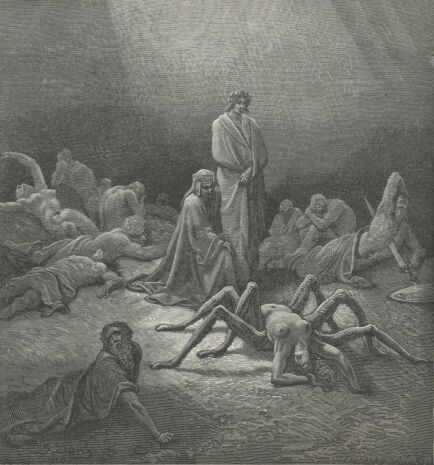
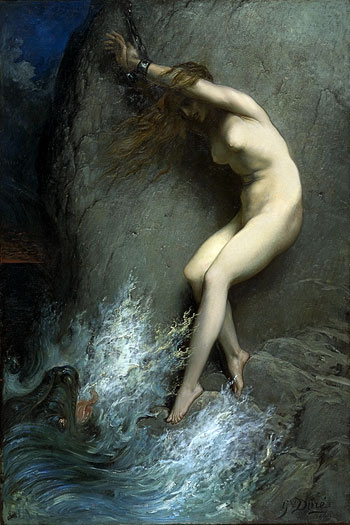
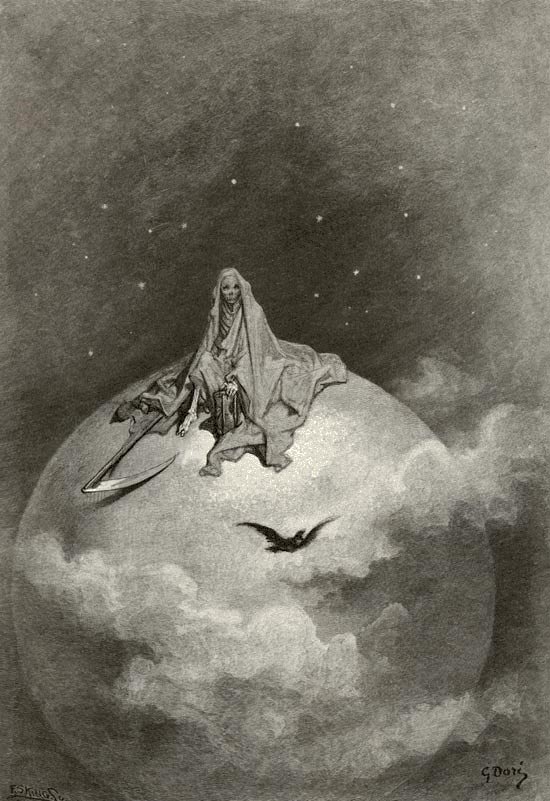
In case you've never seen a Gustave Doré illustration before, here are a couple examples of the coolness:

Arachne

Andromeda
From Edgar Allen Poe's "The Raven"