Monday, October 4, 2010

Doré's Dragons, Demons and Monsters

Dore's Dragons, Demons and Monsters (Dover Pictorial Archive Series)Dore's Dragons, Demons and Monsters by Gustave Doré

My rating: 5 of 5 stars


Gustave Doré is pretty awesome. Few artists' works embed themselves in my mind the way Doré's do. I think seeing his illustrations to works like Paradise Lost, Don Quixote, and The Divine Comedy have excited me to eventually read those stories more than all the talk surrounding these works that I've heard in my English classes. That might mean I'm just a lazy reader, or it might have something to do with the long tradition of illustrations accompanying literary works. These days, it feels to me like such a fusion of the arts is less encouraged, even looked down upon. "Serious" literature doesn't bother with pictures, but is all wrapped up in the magnificence of language (except who's gonna say that Paradise Lost isn't serious literature, or an example of weak language?). Should I blame the modernists who brought us formalism for that? Probably not. In any case, it seems like outside of the (now overly popular and rather bloated) graphic novel, and the (unfairly overlooked) picture & pop-up book, that pictures have been snubbed out of literature. Some might say it's because visual arts have somehow found their way into literary language itself, and that there just isn't a need for it, because some writers adopt a cinematic, visual style anyway. I guess you can argue that such a thing as cinematic language exists, but I think there's room for a counter-argument as well - language has always had a visual or cinematic quality in the hands of the right people. (Now I'm just rambling.) Basically, Doré is pretty fabulous, and we should still read books with pictures.

This modest collection of illustrations from Dover is a great introduction to Doré's work. It's a really good highlight reel, that gives to a solid taste for what he's doing. There are no essays accompanying these illustrations, which might be a bummer to those of us who like reading such things, but it's also really cool to have only the illustrations, standing on their own merits. The illustrations are strong enough on their own that explanation as to why they're so great seems extraneous. (Which might mean this review is irrelevant - just a sign of my own pretentiousness. Fair enough.) Essay and critical work on these pictures is cool, but unnecessary for this particular edition. If I want a more extensive analysis and collection of Doré's works, I'll be able to find them, but this book gives me a satisfying first taste.

The illustrations contained here have a spiritual, mystical, mythical quality that carries them beyond simple depictions of demons and monsters. Horror and the grotesque are here in abundance, but serve as a reminder that there are many things in the world that are much bigger than us and are beyond rational comprehension. Sometimes these things present a very real danger to us, but it doesn't always have to turn out like that. Some of these demons and monsters look rather humorous, and are likely meant to, which makes me think that not everything that appears to be an evil demon always is. And in any case, while the horrors of the rational or irrational world might surround us, this also doesn't mean we will be destroyed by them. Many of the works Doré was illustrating didn't end in the complete destruction of humanity - quite the opposite. So there seems to be a kind of inverted optimism or positivity to the pictures that I find really fantastic.

If this is an artistic style you like, then I'd really recommend checking out this book. If it isn't your style, maybe give it another chance before moving on to your already accepted preferences.

View all my reviews

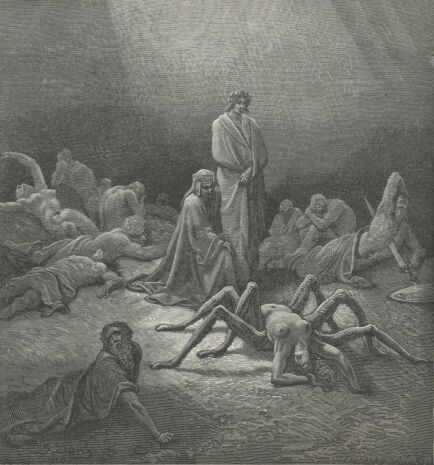
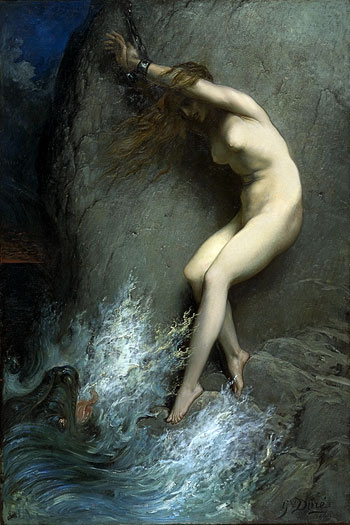
In case you've never seen a Gustave Doré illustration before, here are a couple examples of the coolness:

Arachne

Andromeda
From Edgar Allen Poe's "The Raven"

Sunday, October 3, 2010

Where do we go from here?

This picture was an accident. In my haste to snap a picture of these deer, I forgot to switch my settings. But I rather like the picture. I don't know if it's a good picture, but I do like it.

This is from on top of Hurricane Ridge, Washington. I've been visiting the Washington Peninsula for years, and this was the first time I'd been on Hurricane Ridge. I wanna go back.

Saturday, October 2, 2010

Berlin: a book, a review, and some pictures.

Berlin (Photopocket City)Berlin by Stefan Dauth

My rating: 4 of 5 stars


This book is a wonderful collection of black and white photographs of my favorite city. I felt that this book captured the multitude of personalities, tones, histories, and cultures that make Berlin the fascinating city that it is and has been for at least the last century. Major city landmarks like Berliner Dom, Brandenburger Tor, the Reichstag, and such are all here, but there are also the great pictures of the alley way at Hackesche Hoefe (where you'll always find great graffiti art) and the street book market in from of the Humboldt Universitaet. You also get a good look at some of the people and fashion that populates the city. I like that the while you have the glamorous shots from down at Potsdamer Platz, you also have the less glamorous shots of anarchy symbols painted on walls and peeling, shredded poster ads pasted on the walls advertising concerts, protests and whatever else. A good collection that uses nice camera work to give an interesting portrait of a very vibrant, historical, and modern city.

View all my reviews

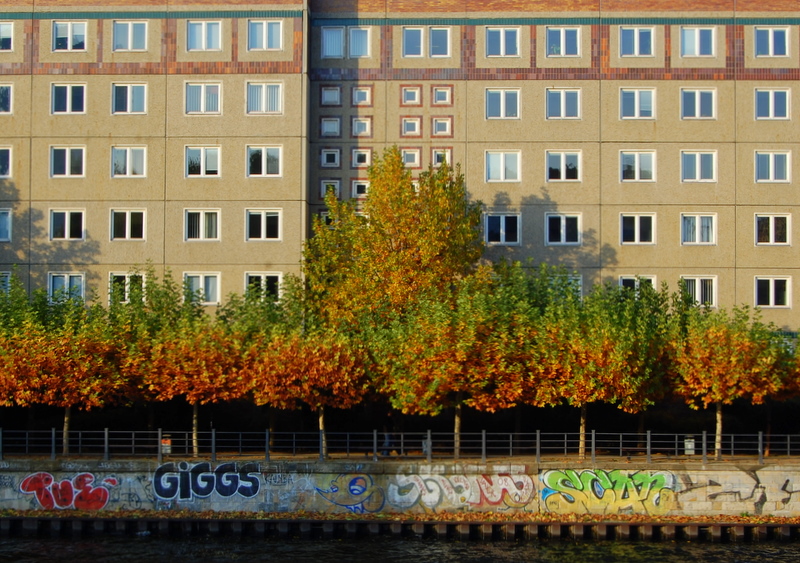
Looking at Dauth's photographs got me all nostalgic for Berlin and I felt like adding some of my own pictures that I took last fall when I was there doing a research project.

Renovations in the Alley at Hackesche Hoefe

Observing the Dead

Modern Times

Fall in the City

Thursday, September 30, 2010

Tuesday, September 28, 2010

Song of the Week: "Everything was Black and White Except the City Lights" - I Hear Sirens

So, a while back me and some chums attended a chill little concert at the ever-charming back alley venue, Kilby Court. We were there to hear Eluvium, one of the more wonderful ambient bands that I know of. Eluvium was really great and the whole concert experience was really unique - it has been a good year for noticeably new concert experiences (i.e. Gene Loves Jezebel & Eluvium). Anyway, preceding Eluvium was a Salt Lake original called I Hear Sirens. Their opening set was quite nice and I sacrificed getting an Eluvium T-shirt so I could get I Hear Sirens' self-titled EP, which is quite good.

"Everything was Black and White Except the City Lights" wasn't played at the concert, but it is my current favorite track on the EP and a good example of what this post-rock band is about. The song isn't overly complicated. Even in the soft piano opener, the song drives forward with a purpose and intensity that isn't interested in doing anything frilly or elaborate, but seems always focused and controlled. The emotion and feeling in the song is nice and impassioned, but never to the point of boring melodrama. It's just a really nice song that probably sticks with me so much because of their seemingly simple and direct approach, which keeps the track strong and meaningful, whereas a more elaborate, flashy approach might have sent the song soaring, only to deflate at the worst possible moment. (Sidenote: I might get stoned for saying this, but Depeche Mode's "One Caress" flops in this way. I think Martin Gore shoulda cut his last repeated chorus to let the orchestra swell and crescendo; as is, Gore's vocals flatten the whole finish, creating an anti-climatic song that boasts some nice lyrics, but ultimately dull music). I Hear Sirens come close to going over the edge, but maintain a firm hold on the pace and tone, knowing when to pull up and rely on less to be more.

At the risk of getting this band wrong by inappropriately inserting characteristics I perceive them to have, I'd say that I Hear Sirens sound like a group who (obviously) like playing music, are a bit introverted and uncertain about some things, while holding to some personal beliefs that mean a great deal to them. They feel things in a way that they believe can be best expressed through music. If they succeed or fail at accurately communicating what they feel is, for me, the lesser goal; the primary objective being more to have felt something at all and to have expressed it - basically, to have done something, gone for something. Maybe sometimes the act of going is far more profound and valuable than whether or not you got anywhere.

Here below is the audio for the song with an image of an old line-up of the band in the studio. Below that is a grainy picture I took at the show.

Enjoy.


I Hear Sirens at Kilby Court, SLC, 5/31/2010

Also, if you like what you hear, there are more tracks to be heard on their myspace page.

Saturday, September 25, 2010

What you wish your research was

I'll bet all you college kids out there wish your research was as cool as mine. Well, keep wishing, because real fun topics like this don't come to just anyone. Last week my African-American Literature class finished reading Richard Wright's impressive novel, Native Son. How Wright used movies, newspapers, and spectatorship was interesting to me and I decided it would be a good paper topic. This led me to this book:

Take special note of how smiley those people are; they're just out having a real good time, I guess. Oh, and then there's this one:

This is the book for the "Without Sanctuary" photo exhibit that made some waves a few years back. This book leaves quite an impression.

America, sometimes you really treat your people like crap.

Wednesday, September 1, 2010

Rock Action

Rock Action

From the Yo La Tengo concert last October. Now almost a year gone by. When school stresses me out, I just take a moment and look at this picture. It does something for me. Something I like.

Sunday, August 29, 2010

Summer Reading 2010

Now that summer has passed and those of us (un)fortunate to be taking classes begin another semester, I thought I'd spotlight a few of my summer reads. It'll be like watching the Emmy's, but a lot less interesting.

I like to think that summer reading is a time to catch up on all those fine things we couldn't read while taking those stuffy university courses where only the serious stuff got read. With summer, we can (perhaps only temporarily) set aside the serious reading, let our hair down, put our feet up and lounge in the bathrobe, enjoying a light read. Leisure reading isn't supposed to be hard, after all. If the point was to think, we'd stay in classes. No, summer is a time for "something I can ignore." But sometimes this weird thing happens where I just can't let the serious stuff go. Basically, I'm often still too uptight and humorless to indulge exclusively in the light and fluffy stuff. And then there are times when words are too hard and I just want pictures - for that there are photography books to look at and admire, though I know nothing about photography. I guess summer allows for anything. Whatever your taste, summer is a time of personal indulgence - at least, it is for me, since I still live at home and avoid any real responsibilities.

Because I'm a geek, I have a list of everything I read this summer, to give a little context to the selections below. There were several nice reads, but only five will receive special recognition here. The winners are:

BEST PICTURES: Ordinary Lives - Rania Matar

Rania Matar's photos of contemporary Lebanon and the people who live there are some of the coolest shots of modern Islamic culture that I've yet seen. These portraits of Muslim women (and some men) living their lives in the bombed out, war-torn cities of Lebanon are hardly the images you find on Fox News - most of Fox's viewers don't know where Lebanon is anyway. Ordinary Lives shows something that, when you think about it, should be quite obvious: the ordinary citizens of Middle Eastern countries like Lebanon are living their lives, in the same general manner that anyone does; you work, have a family, have fun together, go shopping, go to church, listen to iPods, and anything else that the average person might do. But these ordinary lives are living amidst piles of rubble and destroyed, yet still occupied, buildings. Her photos always seem display more than one possible story, which is a helpful reminder to those of us (meaning all of us) who are prone to forget that life and people are complicated. They contain more than one story and deserve to be seen and treated as human beings rather than as just faces in the crowd, or worse, collateral damage.

BEST MUSICAL ACCOMPANIMENT: The Wilco Book - Wilco & Dan Nadal

What's better than a book with soundtrack included? The Wilco Book is an example to all books about artists and bands in how to really please your audience (or just to get them to buy your book): Include a disc of otherwise unavailable material. This doesn't seem like such a bad move since some musicians (i.e. Elvis Costello) have made claims that there's nothing more useless than writing about music. If the music is the center, then stop talking and just listen. While I appreciate the passion behind such statements, I think there's a place for writings about music. However, I still feel that the disc of outtakes and experimental recordings from the A Ghost is Born sessions really is the best part of The Wilco Book. The pictures, interviews, and essays are also interesting and worthwhile to any Wilco fan. But if turning the pages does seem like too much effort, then just hit 'play' on your cd player and enjoy the reason you wanted to read this book in the first place.

KYLIE AWARD: Then There Were None - Martha H. Noyes

Kylie was responsible for four of this summer's reads, either because she lent me her copy (Goth Girl Rising and The Zombie Survival Guide: Complete Protection from the Living Dead), chose it for our monthly reading selection (Howl's Moving Castle), or gave it to me (Then There Were None). All four are very fine reads, but Martha Noyes' short book about the disappearance of native Hawaiians due to American colonialism was the most affecting. It blends photography, historical information, quotes, and poems to give a short, concise, and substantial account of this under-addressed event. The book is more interested in illuminating and expressing the emotions that surround the event, than in presenting a dry historical account that points fingers and demands justice. Its intention is not to stir up anger or controversy, but more to give voice and feeling to a people and culture that have been diminished, overlooked and forgotten, left now to serve only as a tourist attraction. Despite its size, Then There Were None, packs one hefty punch. It contains enough information that I felt completely satisfied, while hoping that someday I could learn even more about Hawaii.

REAGAN AWARD: Don't be Afraid, Gringo - A Honduran Woman Speaks from the Heart: The Story of Elvia Alvarado - Medea Benjamin & Elvia Alvarado

Elvia Alvarado loves Ronald Reagan. Really. She's a big fan of the man who supported a corrupt government that repeatedly oppressed the peasant population of Honduras by taking away their land, denying them jobs and food, and imprisoning, torturing, and killing numerous lower class citizens who spoke out against this foul abuse of power. Alvarado is an impoverished Honduran woman who, through grassroots education and social activism, became a principle player in the lower class movement to reclaim stolen land and begin empowering women and working class citizens with the tools and know-how to survive in a country where all the wealth went to the upper class landowners. Don't be Afraid, Gringo is her story, in her words. The language is clunky and I guess what you would expect from someone who didn't make it past the fifth grade (there was no money to go on further). But the language also has a simple eloquence and straight-forward honesty that transforms these clunky thoughts into brilliant insights on the struggle for survival, recognition, and dignity. Alvarado is a voice from the working class Honduran - a voice that most Americans, including Ronald Reagan, have never heard. As a result of Alvarado protesting and peacefully fighting for the impoverished masses, she has been branded a Communist, arrested multiple times, and even tortured by her police captors. But still she has survived and continues to work towards establishing her vision of democracy. Some of the book's best moments are Alvarado's  thoughts on what a real democracy is and how she doesn't think Reagan is interested in establishing real democracy in Latin America. Ronald Reagan not interested in spreading democracy? Isn't he supposed to be the All-American President and poster-boy of all things Democracy? Not for Elvia Alvarado, and her observations are great and her use of real life experiences to show the injustice of the American-backed Honduran government are some of the best I've read. The book was first released in 1987, while Reagan was still President, but looking at conditions in Honduras (and all through Latin America) today show that there is still a lot of work to do to improve the conditions of the working class citizens. America's destructive involvement in Latin America is a shameful example of contemporary colonialism, and while I'm sure America has done some good down there, accounts like Elvia's show that, most of the time, America's self-interested intervention into Latin American affairs has hurt most the people who deserve it least.

BEST BOOK NOT ABOUT COLONIALISM: Howl's Moving Castle - Diana Wynne Jones

For whimsical young adult fantasy, Howl's Moving Castle is one of the most charming stories. It often doesn't feel like there's much of a story at all, rather it just ambles along, often sitting back and taking its time, simply enjoying watching Sophie interact with these humorous characters. I liked just watching her interact with Calcifer, Michael, and Howl so much that I didn't really care if the story ever went anywhere. Almost like Sophie herself, I kept forgetting that she actually wasn't supposed to be an ornery, yet endearing old woman, and that there really was an obstacle for her to overcome. Jones' style is light and fun, but never void of substance. She has a point to this novel, but she has a rather round-a-bout, light-hearted way of expressing herself. My only issue is one of taste: she uses too many adverbs, especially in the first half of the book. By the latter half, she reigns in the adverbs pretty well. This is a small complaint, and one that I'm very willing to overlook so as to spend more time thinking about all the great things about this book. I know this is a popular book, and I'm aware that I'm a late-comer to Diana Wynne Jones' work - so how good this book is might only be news to me. But it's a fast read, and a fun read; so, if you have the time, I'd recommend revisiting this lovely world.   

Friday, August 27, 2010

Then There Were None

  Then There Were NoneThen There Were None by Martha H. Noyes

My rating: 5 of 5 stars


Then There Were None is a perfectly structured book; it knows what it wants to do, and executes it through a remarkable balance of photographs, quotes, poems, and historical information. This is a quick, concise, and substantial little book that packs one solid punch.

Elizabeth Kapu'uwailani Lindsey Buyers states in the book's forward that the book "is not a tale of blame or vicitmization." Well, it doesn't need to be. The devastation of the Hawaiian people and their culture hardly needs to be told through finger-pointing and victimization. Simply recounting the history and showing their culture is enough, as this book proves.

I also quite like the preface, which asks:

"Has any history text, however objective, quelled the troubles between [warring cultures]?

No, because history isn't what divides them. what fuels the division is emotion.

It is an emotional voice we wanted to offer. If the heart's wounds, the spirit's ache are laid bare, healing balm can reach the injury and ease the pain."

It makes a lot of sense to me. The book does elicit an emotional response, but through a controlled, leveled presentation that doesn't seem negatively manipulative or entrenched in hateful bitterness. Any anger I felt while reading this book is a product of my own rash behavior and not the wishes of the author.

The archival photos are effective both as visual documentation as well as additional narration. They aren't extraneous, but rather work in tandem with the text, using photography's strengths to enhance the narrative beyond what text can do. Since Martha H. Noyes first told this story through a documentary film of the same title, the skillful use of photos comes as no surprise.

What a lovely little book. The cover photo is excellent, the size is great, the length is just right, and the information is substantial throughout. A sad, but wonderful little book.

View all my reviews >>

Wednesday, August 4, 2010

David Bowie & Trent Reznor: The Performance I Never Could Have Seen

Here's a performance that woulda really been something to see. Though I never would have had the chance, as it happened in 1994, and I was only 11 or 12 at the time. At that age I don't think I'd even discovered David Bowie yet. I did, however know about Trent Reznor's Nine Inch Nails, as my brother, Michael, had the Pretty Hate Machine album and, through my 11/12 year old lens, would enjoy tracks like "Head Like a Hole", "Terrible Lie", and "Ringfinger". (I think about that now and can understand why my Mom was bothered and annoyed that Michael would even listen to that album himself, let alone let me listen to it.)

So when David Bowie and Nine Inch Nails hit the stage together during NIN's Downward Spiral tour, I had no idea it was taking place. Now a lotta years have passed and my love of both Bowie and Nails has solidified into a pretty intense amount of love. So it's a real treat to see this footage of these two artists sharing the stage for an impressive performance of the NIN staple "Hurt".


*Thanks to Aaron for sending me the video link.